Dear friends of Yoga:
This piece is being shared because it touches on many of the finer points of Yoga philosophy. Also the references for the piece are second to none.
The publisher is an online vendor of artful things of Indian Yoga and religion. Frequently articles such as this are offered and are available by signing up. See bottom of page.
May you find peace and happiness through your explorations in Yoga.
In the light of Yoga:
John
From Individual Soul to The Supreme: A Study in Identity
Article of the Month - October 2010
Conjecture: In all probability it seems logical to assume that the jiva is of the size of the body itself.
This supposition does however present some issues. During childhood the size of the body is small which grows larger in youth. How does the soul accommodate this change in size? No one can say that it stretches itself. Also, what about rebirth? If we are to take the body of a cockroach in our next life will the soul compress itself, or will it expand if we are to take on the form of an elephant? More importantly, assigning a finite size to soul implies that it is non-eternal, since it is but our common experience that everything with a finite shape or size is ultimately prone to destruction.
What then do the Vedas themselves say in this regard? For one, the scriptures definitely seem to imply that the soul has a size, because they mention its passing out of the body at the time of death, and also its journeying to other worlds:
'The soul passes out of the body at the time of death, carrying along with it speech and other sense organs' (Kaushitaki Upanishad 3.4).
'To reap the fruits of its karma, the soul ascends to the region of the moon' (Kaushitaki Upanishad 1.2).
'The soul returns to the mortal world again to do fresh karma' (Brhadaranyaka Upanishad 4.4.6).
Conjecture: If the individual soul was really infinite like the Supreme Soul, there would be no possibility of its movement. We have already seen that it cannot be of the size of the body. Since it is neither infinite, nor finite in size, therefore, it must be atomic in size, as declared by the scriptures:
'The soul is a hundredth part of the hundredth part of the tip of a hair' (Shvetashvatara Upanishad 5.9).
'The soul is finer than the tip of a pointed iron goad' (Shvetashvatara Upanishad 5.8).
 A Refreshing Bathe in the River Ganga |
Objection to the Conjecture: If the soul is atomic in size, it will be located at only a single point in the body, this will contradict our everyday experience that the whole body is conscious of a refreshing coolness when we bathe in the river Ganga, or in the summers we are conscious of heat all over our body.
Atomist: No, it is not a contradiction. Just as a drop of sandal paste (chandan), applied only to a particular part of the body, nevertheless produces a pleasant sensation all over the body, similarly the soul, even though located at only one part of the body, due to its contact with the skin (the organ of touch), derives the experience of pleasure and pain all over the body, because the skin is spread all over the body.
Question: This is an inadequate comparison. In the case of the sandal paste, we can directly perceive both, its point of application and the subsequent diffused experience of pleasantness all over the body. In the case of the soul however, we are aware of it only through the consciousness of pleasure and pain all over the body, but cannot at all pinpoint its exact location in the body as we can do for the sandal paste. Thus, we cannot say with certainty whether it is atomic in size with an exact location, or all-pervading like the akasha, as mentioned in the scriptures.
Atomist: This presents no problem at all. The Upanishads clearly mention the soul as residing in the heart (Brhadaranyaka Upanishad 4.3.7; Prashna Upanishad 3.6; Chandogya 8.3.3; Taittriya 2.1). So now we not only have the perception of the soul all over the body in the form of consciousness, but also its exact location inside the body. Hence, we can now safely reiterate that the individual soul (jiva atma) is atomic in size.
Or there is even another way which easily explains how the atomic soul even though located at one point in the body is experienced as consciousness all over it. Consider the example of a lamp kept in a one part of a room. Its light spreads over the whole room, similarly, the consciousness of the soul spreads all over the body and causes us the experience of pleasure and pain.
Objection to Atomist: The quality of a thing does not wander away beyond that thing in which it inheres. The whiteness of a piece of cloth remains in it and not beyond. In fact, light is not a quality of the flame, it is a substance (matter), just like the flame itself. Light in its maximum density is the flame (lamp), and in the diffused state it is light (Shankaracharya's Commentary on the Brahma Sutras 2.3.26).
Here we have the great Shankaracharya declaring light to be 'matter'. More than a thousand years later, Albert Einstein would receive the Nobel prize for discovering the same.
How Does Vedanta Resolve this Issue?
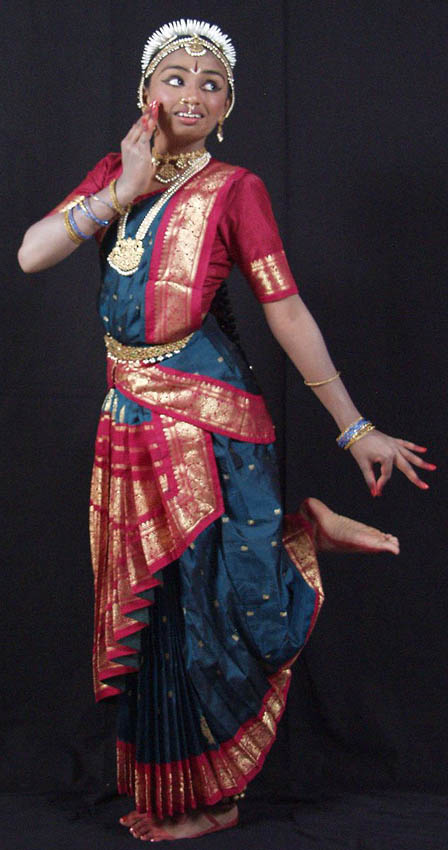 A Classical Dancer Enacts the Pricking of a Thorn in the Sole of Her Feet |
It is unequivocally declared that jiva is non different from the Supreme Soul (God). Therefore, it has to be as big as the Supreme Soul, which is all pervading. Otherwise, we cannot experience the sensation of pleasure and pain extending all over the body. To say that such an experience is possible on account of the soul's connection with the skin extending all over our body, is to negate our own actual experience. The pain of a thorn pricking the sole of our feet is located at the sole and not experienced all over the body.
Nor can it be said that the jiva pervades the entire body by means of its quality of consciousness, for if the jiva is atomic in size, its quality must reside in it, and cannot go beyond it in order to pervade the entire body. A quality which wanders beyond the substance ceases to be a quality. The light of the lamp which goes beyond the flame is a part of the flame itself, and not separate from it. In essence, the flame and its light are not two different things, i.e., we cannot say that the soul is somewhere else and its influence somewhere else. Wherever its influence is being experienced, there the soul is present too. There is no example in our experience where we can say that an object is situated somewhere and its influence is being distributed elsewhere independent of it. Like the power is non different from the one wielding it, similarly, any quality is non different from the object possessing it. The quality and its possessor cannot be separate, they can exist toge! ther only.
If consciousness, as the inherent quality of the soul is said to pervade the whole body, it is as good as saying that the soul is not atomic in size. Because, consciousness is nothing but the innate nature of the soul. We have already seen above that the soul is not of the size of the body. By default then, it has to be all-pervading or infinite.
Objection: Why then is the soul described as minutely small, and residing in the heart?
Resolution: Due to the imposition of the qualities of the buddhi (intellect) on to the soul. When the qualities of the buddhi, i.e. desire, aversion, pleasure or pain are superimposed onto the faultless soul itself, then is the latter spoken of as being atomic, the size of the buddhi, which is said to reside in the heart. Fundamentally, the soul is eternally free from these qualities.
The Shvetashvatara Upanishad says: 'The soul is a hundredth part of the hundredth part of the tip of a hair, and yet it is infinite.' (5.9). Now the same soul cannot possess these contradictory attributes. According to 'Tat Tvam Asi', the individual soul, being nothing but the Supreme Soul, must be infinite like the latter. Therefore, the atomic size must be understood as simply metaphorical or conditioned by the qualities of the buddhi. This is clear from the statement: 'The jiva is like the tip of a goading stick on account of it being endowed with the qualities of the buddhi, and not on account of its own true nature' (Shvetashvatara Upanishad 5.8).
The statement that: 'the individual soul is atomic, and is to be known only through the inner light'(Mundaka Upanishad 3.1.9), is not meant to indicate that the soul is atomic in size, but rather that the Supreme Soul (God) cannot be apprehended by the sense organs turned outwards, but only when they are withdrawn from the outside world. This is precisely the reason why it is said to be located inside the heart. The word atomic is used to make us understand that the soul is too subtle to be discerned, it in no way describes the innate true nature of the soul, which is identical with the infinite Supreme Soul (God or Brahman).
It is the metaphorical ascription of the qualities of the buddhi to the soul that is echoed in the other scriptural passages quoted above. The Prashna Upanishad clearly states that the passing out of the soul from the body and its consequent departure to other regions and then coming back to this mortal world is falsely ascribed to the soul on account of the upadhi of the buddhi and prana (Prashna Upanishad 6.3-4). The soul can never be spoken of as leaving the body, since what leaves is the prana and not the soul. In other words, just as the infinite God is spoken of as 'smaller than a grain of rice', for the purpose of devotion (Upasana), even so the soul is said to be atomic so long as the qualities of the buddhi are superimposed on to it.
As a matter of fact, there is nothing like an individual soul (jiva), except the Supreme Soul appearing as jiva on account of the upadhi of the buddhi. For throughout the Upanishads we do not we do not meet with any other conscious principle other than the One and Only Supreme God.
Conclusion: What is the Use of This Analysis?
Vedanta purposefully starts off by pointing out to us that even though we identify ourselves, and others too, exclusively through the physical body, we are in fact different from it. When a person dies, even though his physical body is lying in front of us, it is inert. What this shows is that by itself the physical world is inert, and it is powered some conscious power which is independent of the physical forms. Therefore, there is something different from the body which grants it consciousness. This is what is known as the individual soul.Once we have logically recognized the presence of a soul in the body, we then set out to determine its physical size. Proceeding step by step we realize that it can neither be the size of the body (finite), nor can it be atomic. Thus, it has to be all pervading, as concluded by the scriptures. It is only because we perceive the soul conditioned by the qualities of the buddhi, mind etc, imposing these on to the eternally pure soul, that the Vedas speak of it as having an atomic size situated inside the heart, making us understand in the process that unless we withdraw inwards from the outside world, there is no hope for salvation.
Finally, this analysis by Shri Shankaracharya Ji makes us realize that even though we are all pervading, we wrongly think of ourselves as confined within the limits of this one single body. We think of ourselves as only 'this much,' and the rest as different from us, thus getting too much attached to our own body and the things associated with it, despising others which we perceive as inimical to the interests of our physical world. It is this raga (attachment) and dvesha (aversion) that this analysis helps us in overcoming.
References and Further Reading:
- Baba, Bhole. Shri Shankaracharya's Commentary on the Brahma Sutras with the Sub-Commentary 'Ratnaprabha' (Text and Hindi Translation), Varanasi, 2006.
- Bharati, Swami Paramananda. Foundations of Dharma. Bangalore 2008.
- Bharati, Swami Paramananda. Lectures on Vedanta (80 MP3 Files).
- Bharati, Swami Paramananda. Vedanta Prabodh: Varanasi, 2010.
- Date, V.H. Vedanta Explained (Samkara's Commentary on The Brahma-sutras in Two Volumes) Delhi, 1973.
- Date, V.H. Upanisads Retold (2 Volumes) New Delhi, 1999.
- Gambhirananda, Swami (tr.) Brahma Sutra Bhasya of Sankaracarya Kolkata, 2009.
- Goyandka, Shri Harikrishnadas. Translation of Shankaracharya's Commentary on the Eleven Upanishads (Hindi): Gorakhpur, 2006.
- Gupta Som Raj. Upanisads with the Commentary of Sankaracarya, Five Volumes. Delhi
- Jacob, G.A. A Concordance to the Principal Upanisads and Bhagavadgita. Delhi, 1999
- Sivananda, Swami. Brahma Sutras Rishikesh, 1999.
This Article by Nitin Kumar.
This article is based almost entirely on the teachings of Param Pujya Swami Paramanand Bharati Ji. However, any error is entirely the author's own.
To view the online version of the article, please click on
http://www.exoticindia.com/
To forward this article to a friend, please click on
http://www.exoticindia.com/
For a Printer friendly Version of the above article, please visit http://www.exoticindia.com/


